The GARDEBRUK 6×8ft is the best greenhouse for most UK gardens in this shortlist. Its 4.8m² footprint is useful without dominating an average plot, and the kit includes a galvanised steel foundation, two roof vents and twin-wall polycarbonate panels. Choose the Palram Mythos if manufacturer support and a more established accessory system justify the premium, or a VonHaus covered model when price, portability or a very small footprint matters more than permanence.
Quick answer: the best greenhouses in the UK
- Best overall: GARDEBRUK 6×8ft — a practical full-size polycarbonate kit with base and ventilation.
- Best premium: Palram Canopia Mythos 6×8ft — an established aluminium system with included base and warranty.
- Best polytunnel: VonHaus 2×3m — substantial growing area for a much lower initial cost.
- Best compact walk-in: VonHaus Six-Shelf — narrow enough for a patio while giving standing access.
- Best mini: VonHaus Four-Tier — seedling and pot protection in a 50 × 45cm footprint.
A greenhouse is not one interchangeable product type. A rigid 6×8ft structure is a long-term garden project; a polytunnel prioritises growing area and value; a shelved plastic growhouse is seasonal equipment. Decide how permanent the structure should be before comparing prices.
In This Article
- How we chose
- Comparison at a glance
- Five best greenhouses
- Head-to-head recommendation
- Choose size and glazing
- Base, anchoring and ventilation
- Planning and growing practicalities
- Frequently asked questions
- The bottom line
How we chose
We compared the decisions that affect ownership after the box arrives: usable footprint, ridge and eaves height, glazing or cover material, included base, ventilation, door access, anchoring, assembly complexity, replacement parts and how permanent the structure is. The cheapest greenhouse is poor value if its cover needs replacing quickly or its frame cannot be secured on the intended site.
This is a specification-led buying guide, not a claim that every model was installed and grown in for a season. Dimensions and included components were checked against the exact products available to UK buyers. Marketing claims about weather resistance, warmth and crop performance were not treated as guaranteed outcomes; siting, assembly, anchoring, ventilation and local exposure matter too much.
We also kept the categories distinct. A mini growhouse can protect trays and young plants but cannot replace the workspace of a walk-in greenhouse. A polytunnel provides inexpensive volume but normally needs more deliberate ground anchoring and cover maintenance. The two rigid 6×8ft kits are the relevant choices for buyers planning a permanent structure.
Comparison at a glance
| Greenhouse | Best for | Cover | Footprint | Key point |
|---|---|---|---|---|
| GARDEBRUK 6×8ft | Best overall | Polycarbonate | 250 × 190cm | Foundation and two roof vents |
| Palram Canopia Mythos 6×8ft | Best premium | Twin-wall polycarbonate | About 244 × 185cm | Established system and five-year warranty |
| VonHaus 2×3m Polytunnel | Best polytunnel | PE cover | 300 × 200cm | Good growing area for the price |
| VonHaus Six-Shelf Walk-In | Best compact walk-in | PVC cover | 143 × 73cm | Shelving included |
| VonHaus Four-Tier Mini | Best mini | PVC cover | 50 × 45cm | Tiny patio footprint |
Dimensions are approximate product measurements rather than the size of the foundation you must prepare. Allow working room around the structure for assembly, panel replacement, gutter access and cleaning. Recheck the current listing and manual before building a base because variants can differ.
The five best greenhouses
1. GARDEBRUK 6×8ft: best overall

The GARDEBRUK is the strongest all-round choice because its 250 × 190cm footprint gives about 4.8m² of growing space and the package covers several essentials. It uses 4mm twin-wall polycarbonate panels in an anodised aluminium frame, with a galvanised steel foundation, two opening roof vents, sliding door and gutter outlets. For tomatoes, cucumbers, peppers and staging, 6×8ft is large enough to create distinct growing and working areas without becoming an enormous project.
The trade-off is assembly and finish. Lightweight aluminium kits need a square, level base; small errors at the foundation become awkward panel and door alignment later. Twin-wall panels diffuse light and are lighter than glass, but they can flex or lift if clips, seals and anchors are poorly fitted. Treat the supplied foundation as part of an anchoring system, not permission to place the greenhouse loose on soil.
- Buy it if: you want a useful permanent-size greenhouse with base and ventilation included.
- Skip it if: the site is exposed and you are unwilling to build and anchor a level foundation carefully.
- Main compromise: good specification for the price, but careful assembly determines how solid the finished structure feels.
2. Palram Canopia Mythos 6×8ft: best premium
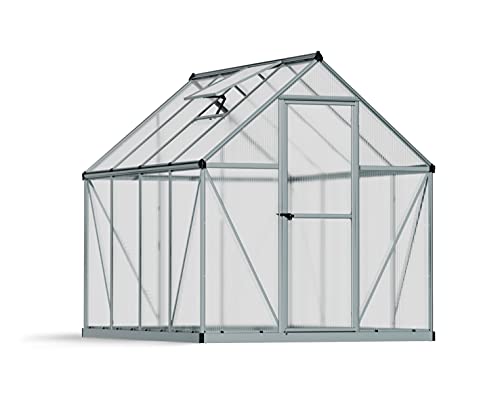
The Palram Mythos targets the same broadly useful 6×8ft size but comes from an established greenhouse system with accessories and replacement support. Its twin-wall polycarbonate panels sit in a rust-resistant aluminium frame, and the kit includes a galvanised steel base, roof vent and gutters. Palram states more than 70% light transmission and a five-year limited manufacturer warranty.
This costs considerably more than the GARDEBRUK while supplying only one standard vent, so the premium is not simply buying a larger greenhouse. It pays for the brand ecosystem, documentation and a product that has been sold in multiple versions for years. Check whether extra automatic vent openers, staging and anchoring hardware fit the exact Mythos variant before ordering them.
- Buy it if: you value an established manufacturer, documented system and longer-term accessory route.
- Skip it if: maximum growing area per pound is your priority.
- Main compromise: stronger ownership proposition, but the initial price is high for a 6×8ft twin-wall greenhouse.
3. VonHaus 2×3m Polytunnel: best polytunnel

The VonHaus polytunnel provides roughly 6m² of covered growing space for far less than either rigid greenhouse. It uses a galvanised steel frame, a fitted PE cover, hinged access and roll-up mesh windows. The cover has extended edges intended to be buried, while ropes and pegs add restraint. That makes it useful for allotments, vegetable beds and growers who value space more than a glasshouse appearance.
Its low price reflects a less permanent structure. The cover will experience more movement and wear than rigid panels, especially at frame contact points. Pegs alone are not a serious answer on an exposed plot; prepare the ground, bury the skirt as directed and consider stronger anchors where site rules permit. Ventilation also requires active management because a large plastic tunnel can warm quickly in sun.
- Buy it if: you want maximum protected growing area at a modest price.
- Skip it if: you want a permanent architectural feature or cannot anchor into the ground.
- Main compromise: excellent space value, but cover life and wind security demand more attention.
4. VonHaus Six-Shelf Walk-In: best compact greenhouse
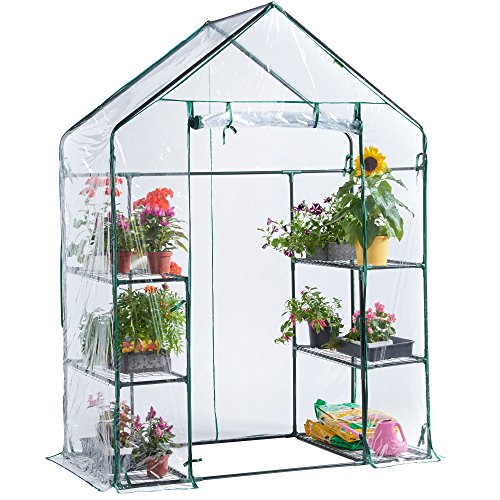
At 143cm wide and only 73cm deep, this VonHaus walk-in model fits against a wall, fence or sheltered patio while still giving access down the middle. Six wire shelves provide space for seed trays, herbs and small pots, with an 8kg stated limit per shelf. The roll-up zipped PVC cover and slot-together frame make it much simpler to assemble or store than a permanent greenhouse.
The narrow footprint is also the limitation. It suits propagation and smaller plants, not a season of tall tomatoes on both sides of the aisle. Shelves, a light frame and a tall cover create wind leverage, so it must be tied to a stable support or securely weighted according to the instructions. PVC covers can also age in strong sun and cold, making sheltered placement sensible.
- Buy it if: you need walk-in access and shelving in a narrow garden or patio space.
- Skip it if: you want beds, large crops or a structure that can be left exposed without seasonal attention.
- Main compromise: much more usable than a mini cover, but still a lightweight growhouse rather than a permanent greenhouse.
5. VonHaus Four-Tier Mini: best mini greenhouse
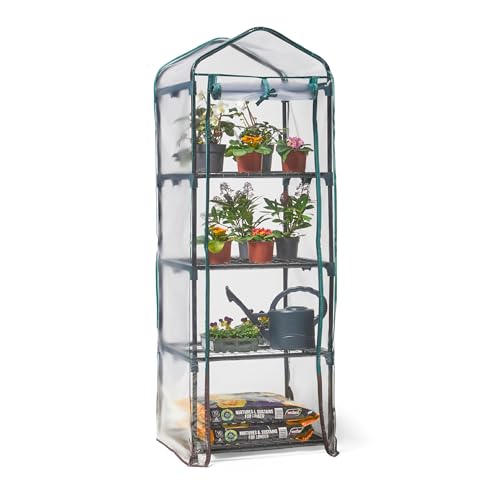
The four-tier VonHaus is designed for seedlings, cuttings and small pots rather than full-height crops. It measures about 158 × 50 × 45cm and supplies four wire shelves, each with a stated 8kg capacity. The roll-up zipped PVC door gives simple access and some ventilation, while tool-free assembly makes the unit easy to move or dismantle.
Its tiny footprint is useful beside a back door or on a sheltered balcony, but the upper shelves can become warm quickly in sunshine. Open the cover before temperatures climb, keep heavy pots low and attach the frame securely so wind cannot tip it. Removing shelves can create extra height for one or two plants, though doing so reduces the main reason for buying a tiered design.
- Buy it if: you want compact protection for trays and pots near the house.
- Skip it if: you expect walk-in access or space for substantial summer crops.
- Main compromise: minimal footprint and cost, but limited stability, ventilation and growing volume.
Head-to-head: which greenhouse should you buy?
Buy the GARDEBRUK 6×8ft if you want the best balance of useful size, included components and price. Its second roof vent is valuable compared with many entry kits, while the foundation and gutters reduce the number of immediate extras. The Palram Mythos is the better premium decision when documentation, accessory compatibility and manufacturer continuity matter more than initial value.
Choose the VonHaus polytunnel for an allotment or vegetable plot where growing area per pound is the priority. Pick the compact six-shelf model for a narrow patio, and the four-tier version only when trays and pots are the entire brief. The biggest mistake is comparing all five as though they perform the same job. A £20 mini greenhouse is not a bargain alternative to a 6×8ft structure; it is a different tool.
The other common mistake is spending the whole budget on the kit. A level base, anchors, staging, automatic vent opener, thermometer and water access can matter more in daily use than a cosmetic frame colour. Price those before deciding which greenhouse fits the budget.
How to choose greenhouse size and glazing
Choose size by the internal layout
Mark the footprint on the ground, then add beds, staging and an aisle on paper. A 6×4ft greenhouse is workable for one bed and narrow staging, while 6×8ft gives more freedom to separate tall crops from propagation space. Going larger is useful only when the site, base budget and maintenance commitment grow with it. The seed-starting equipment guide helps identify how much staging space you really need.
Glass or polycarbonate
Horticultural glass offers clear views and good light but breaks into sharp pieces. Toughened safety glass is stronger and breaks differently, but costs more. Twin-wall polycarbonate is lighter, diffuses light and is easier to handle during assembly; it can scratch, attract condensation within channels and needs secure panel retention. Check panel thickness and replacement availability rather than accepting “polycarbonate” as a complete specification.
When a polytunnel makes more sense
A polytunnel is the value choice for rows of crops and allotment-scale growing. It is less suited to a formal patio or a site where ground anchoring is impossible. Cover replacement is a normal ownership cost, not necessarily a failure. If your main aim is tomatoes, our guide to growing tomatoes in the UK compares protected and outdoor approaches.
Base, anchoring and ventilation
Build a square, level base
Measure diagonals as well as sides: equal diagonals confirm a rectangular base is square. Follow the manufacturer’s foundation dimensions and fixing pattern. Paving, concrete, treated timber or a proprietary metal base can work depending on the structure, but the surface must resist settlement and allow secure anchoring. Do not use an approximate generic trench specification in place of the manual.
Anchor for the site
Wind exposure depends on surrounding buildings, fences, trees and local topography. Fix rigid frames to their base and foundation; bury polytunnel skirts and use suitable ground anchors; tie lightweight growhouses to a stable support or ballast them as directed. Close and secure doors and vents before strong winds. A greenhouse placed in a sheltered position still needs anchoring.
Provide controllable ventilation
Roof vents release hot air, while lower vents and an open door help replace it. Automatic openers are useful when nobody is home to react to sunshine, but confirm their weight and fitting compatibility. Shade and ventilation solve different problems: shade reduces solar gain, while vents exchange air. Monitor conditions at plant height rather than relying on the weather forecast alone.
Plan water at the same time. Gutters can feed a water butt, while an internal line or stored cans reduce carrying. For unattended beds, compare the options in our guide to greenhouse and garden watering systems.
Planning and growing practicalities
Check planning and site rules
Many domestic greenhouses fall within permitted development limits, but the detailed rules depend on location, height, boundaries, designated land and the property itself. Check the current Planning Portal guidance for outbuildings and ask the local planning authority when the site is unusual. Allotment agreements may impose separate size, material or anchoring rules.
Plan crops before staging
Use the warmest, brightest zones for crops that need them, and avoid filling the entire greenhouse with fixed shelving before tall plants develop. Tomatoes, peppers and cucumbers can benefit from protection, but variety, feeding, watering and disease management still determine results. The month-by-month planting guide helps sequence propagation and outdoor transfers.
Manage seasonal extremes
An unheated greenhouse buffers weather but does not guarantee frost-free conditions. Use a maximum-minimum thermometer, ventilate on bright days and add targeted protection when forecasts demand it. Heating a leaky structure can be expensive; a small propagator or local fleece may be a more proportionate answer. Save seed and plan next season with the seed-saving guide rather than assuming every crop should remain under cover all year.
Frequently Asked Questions
What size greenhouse is best for an average UK garden?
A 6×8ft greenhouse is a useful starting point for many gardens because it accommodates beds, staging and an aisle. Mark the footprint and internal layout before ordering.
Is glass or polycarbonate better?
Glass gives a clear traditional finish, while twin-wall polycarbonate is lighter and diffuses light. Safety, replacement availability, frame design and budget should decide the choice.
Does a greenhouse need a base?
A rigid greenhouse needs a square, level and securely anchored foundation or base system. Lightweight growhouses and polytunnels also need appropriate anchors even though they do not use the same foundation.
Do I need planning permission for a greenhouse?
Often not, but permitted-development rules have conditions and exceptions. Check current Planning Portal guidance, local restrictions and any allotment agreement before building.
Can an unheated greenhouse be used in winter?
Yes, for storage, hardening and protecting suitable plants, but it is not automatically frost-free. Monitor minimum temperatures and add targeted protection when required.
How should I secure a plastic greenhouse?
Follow the manufacturer’s anchoring instructions, place it in a sheltered position and attach it to a stable support or suitable ballast. Remove or secure the cover before severe weather if advised.
The bottom line
The GARDEBRUK 6×8ft is the best greenhouse for most buyers here because it combines a useful footprint, twin-wall panels, foundation, gutters and two roof vents at a sensible price. Pay more for the Palram Mythos when an established system matters, choose the VonHaus polytunnel for economical growing area, or select one of the compact VonHaus growhouses when space is the real constraint. Whichever you buy, budget for a level base, secure anchoring and controllable ventilation before spending on accessories.