Choosing the right apple tree for a UK garden comes down to three things: your space, your soil, and whether you want apples for eating, cooking, or pressing. Get those right before you fall for a romantic variety name. A Bramley on the wrong rootstock can outgrow a small garden; a lovely dessert apple can crop badly without a pollination partner; a cider apple may be pointless if you only have room for one tree. The good news is that UK gardeners have excellent options, from compact self-fertile dessert apples to proper cider varieties for a small home orchard.
In This Article
- Choosing Apple Trees for UK Gardens: What Matters Most
- Understanding Rootstocks: Sizing Your Apple Tree
- The Best Dessert Apple Varieties for Eating Fresh
- Top Cooking Apple Varieties for UK Gardens
- Cider Apple Varieties for Home Pressing
- Mastering Pollination: Groups, Partners and Triploids
- Growing Apples in Small Spaces and Containers
- Storage, Disease Resistance and Buying Tips
- Frequently Asked Questions
- Bottom Line
Choosing Apple Trees for UK Gardens: What Matters Most
Start with use, not nostalgia. If you want apples straight from the tree, choose a dessert variety with reliable flavour in your part of the UK. If you bake, freeze or make chutney, pick a cooker that suits your space rather than defaulting to the most vigorous Bramley. If you want cider, be realistic about pollination, yield and whether you have room for more than one tree.
- Space: match the rootstock to the garden, not just the variety to your taste. A good tree on the wrong rootstock is still the wrong tree.
- Sun: apples crop best with at least half a day of sun. In shade, favour reliable varieties such as ‘James Grieve’, ‘Grenadier’ or naturally compact trained forms on the brightest fence.
- Soil: apples like fertile, well-drained soil. Heavy clay can work if improved with compost and planted slightly proud; waterlogged ground is the bigger problem.
- Region: northern, exposed or wet gardens suit tougher varieties such as ‘Discovery’, ‘James Grieve’, ‘Grenadier’ and ‘Lord Derby’. Warm sheltered sites can handle fussier classics like ‘Cox’s Orange Pippin’.
- Pollination: check compatibility before buying. A tree label that says “Group 3” is not decoration; it tells you whether the tree will set fruit with your other apples.
The RHS apple cultivar guide is useful for checking variety traits, but nursery descriptions still matter because they normally state rootstock, pollination group and final size.
Understanding Rootstocks: Sizing Your Apple Tree
Apple varieties are grafted onto rootstocks. The variety gives you the fruit; the rootstock controls size, vigour, how soon it crops and how much support it needs. For UK gardens, this is often the most important buying decision.
Rootstock Sizes That Matter
- M27: the smallest common option, usually around 1.5m. Good for containers and tiny gardens, but it needs rich soil, regular watering and permanent support.
- M26: a better small-garden all-rounder, usually 2-2.5m. Works for large containers, compact bush trees and some trained forms.
- M9: similar dwarfing size to M26 and crops early, but dislikes drought, poor soil and neglect. More common in commercial systems than relaxed home gardens.
- MM106: the standard semi-dwarf rootstock for many UK gardens, reaching roughly 3-4m as a bush tree. Good for larger borders, cordons and espaliers.
- MM111 and M25: vigorous choices for orchards and large rural gardens. Usually too much tree for a suburban plot.
For a patio, choose M27 or M26. For a small to medium garden, M26 or MM106 is usually the sweet spot. For a traditional orchard, MM106, MM111 or M25 can make sense. Dwarf trees crop earlier, often within two or three years, but they also need more careful watering and feeding. A bigger rootstock takes longer to settle but is more forgiving once established.
My Default Rootstock Choice
If you are unsure, MM106 is still the default for a normal garden border, while M26 is safer for a small garden where you want fruit within reach. I would only choose M27 if the tree is going into a pot and you are happy to water it properly through summer.
If container growing is the plan, our guide to growing fruit in containers covers pot sizes, compost and watering in more detail.
The Best Dessert Apple Varieties for Eating Fresh
Dessert apples are the ones you pick and eat fresh. For most small UK gardens, I would prioritise flavour, disease resistance and reliable cropping over supermarket-style shine.
Reliable Dessert Apples
- ‘Discovery’: early, juicy and reliable, ripening from late August into early September. It is one of the safest choices for cooler UK areas, though it does not store for long.
- ‘Egremont Russet’: a Victorian russet with firm flesh and a nutty flavour. Naturally compact, dependable and useful if you want something more interesting than a standard red apple.
- ‘James Grieve’: Scottish-bred, tangy, very juicy and good in northern or exposed gardens. It can be eaten fresh, juiced or lightly cooked.
- ‘Cox’s Orange Pippin’: superb flavour in the right place, but not the easiest tree. It wants warmth, shelter and decent disease management, so I would not choose it for a cold wet plot.
- ‘Red Windsor’: a strong small-garden choice because it is compact, self-fertile, productive and easier than Cox while still having good flavour.
- ‘Scrumptious’: sweet, early and scab-resistant, with a compact habit that suits smaller spaces.
- ‘Rajka’: crisp, red, juicy and disease-resistant. A good option for organic or low-spray gardens.
- ‘Katy’: Swedish-bred, reliable in cool summers and useful for both eating and juice.
If you only have space for one dessert apple, ‘Red Windsor’ or ‘Scrumptious’ would be my starting point. If flavour matters more than convenience and you have a warm sheltered garden, ‘Egremont Russet’ is the more characterful choice.
I would be cautious with ‘Cox’s Orange Pippin’ unless you specifically want the challenge. It is famous for good reason, but modern easier apples are a better bet for most gardens that are damp, windy or only partly sunny.
Top Cooking Apple Varieties for UK Gardens
Cooking apples are not just sour eating apples. The best ones soften properly, hold enough acidity and give pies, sauces and chutneys the flavour you expect from British cookery.
Best Cookers for Gardens
- ‘Bramley’s Seedling’: the classic cooker: large, sharp and fluffy when cooked. It is vigorous and triploid, so use a dwarfing rootstock in normal gardens and remember it needs two compatible pollination partners.
- ‘Grenadier’: early, reliable and easier to manage than Bramley. It breaks down well for sauces and suits poorer or more exposed sites.
- ‘Howgate Wonder’: huge fruit, useful for cooking and eating when fully ripe. It stores well but is a vigorous tree, so rootstock choice matters.
- ‘Lord Derby’: a good northern and wetter-climate cooker. It stays firmer when cooked, which makes it useful for pies and tarts rather than only purée.
- ‘Rev. W. Wilks’: an early cooker on a smaller tree, worth considering where Bramley would be too much.
For small gardens, ‘Grenadier’ or ‘Rev. W. Wilks’ is often the more sensible choice. Bramley is brilliant, but only if you have the space and pollination setup for it. Buying a Bramley as your only apple tree is one of the quickest ways to wait years for disappointing crops.
Cider Apple Varieties for Home Pressing
Cider apples are worth growing if you have room for at least a small collection of trees. True cider varieties bring tannin and structure that dessert apples lack, but they are not always the best use of space in a tiny garden.
Proper Cider Varieties
- ‘Dabinett’: a classic bittersweet cider apple, relatively compact, reliable and disease-resistant. One of the best first cider choices.
- ‘Kingston Black’: famous for rich single-varietal cider, but it needs a good summer and is triploid, so plan pollination carefully.
- ‘Yarlington Mill’: vigorous, heavy-cropping and tolerant of less-than-perfect soils. Good for blending.
- ‘Michelin’: productive, mild bittersweet and useful in blends.
- ‘Harry Masters Jersey’: a traditional Somerset bittersweet with reliable cropping in many UK regions.
If you have one small garden tree and only press occasionally, a dual-purpose apple such as ‘Katy’ or ‘James Grieve’ is more practical. If you have room for a few trees, ‘Dabinett’ plus compatible dessert or cooker partners gives you a better starting point for home pressing.
Do not plant a cider apple just because the idea sounds nice. If you are unlikely to press fruit every autumn, a dessert apple that also juices well will give you more value from the space.
Mastering Pollination: Groups, Partners and Triploids
Pollination is where many otherwise good apple plans fall over. Most apples are not reliably self-fertile, so they need another compatible variety flowering at the same time. Apple pollination groups run from Group 1, the earliest flowering, to Group 5, the latest. In practice, pair trees from the same or adjacent groups.
Pollination Groups in Plain English
- Group 1: very early flowering, such as ‘Irish Peach’.
- Group 2: early to mid, including ‘Discovery’ and ‘James Grieve’.
- Group 3: mid-season, including ‘Egremont Russet’ and ‘Cox’s Orange Pippin’.
- Group 4: mid to late, including ‘Bramley’s Seedling’.
- Group 5: late flowering, such as ‘Suntan’.
The RHS apple pollination groups PDF is handy when checking named varieties. Do that before you buy, not after planting.
Triploids and Crab Apples
Triploid varieties need special attention. ‘Bramley’, ‘Kingston Black’ and ‘Gravenstein’ produce poor or sterile pollen, so they cannot pollinate other trees. If you plant a triploid, you normally need two different non-triploid compatible varieties nearby. A crab apple such as ‘John Downie’ or ‘Golden Hornet’ can also help because crab apples flower over a long period and fit into many pollination plans.
For a simple small-garden setup, choose one self-fertile apple such as ‘Red Windsor’ or plant two non-triploid varieties from neighbouring groups. For a more resilient garden, mix eating, cooking and crab apple varieties so blossom overlap is less fragile in a cold spring.
Growing Apples in Small Spaces and Containers
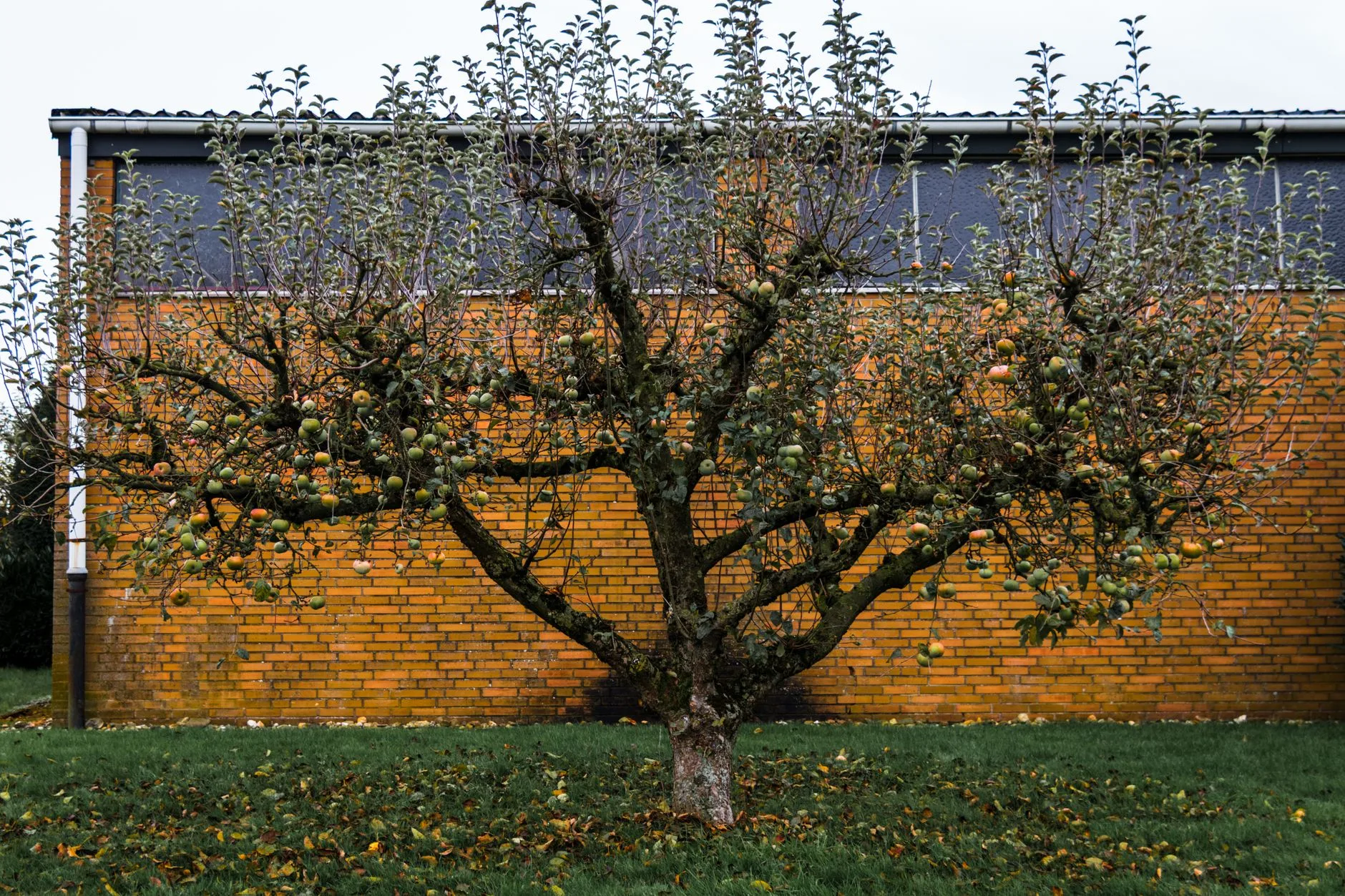
You do not need an orchard. A dwarf tree in a large pot, a cordon along a sunny fence or an espalier on a boundary can give a worthwhile crop in a small UK garden.
- Best small-space dessert apples: ‘Red Windsor’, ‘Scrumptious’ and ‘Egremont Russet’.
- Best small-space cooker: ‘Grenadier’ or ‘Rev. W. Wilks’ on a dwarfing or semi-dwarfing rootstock.
- Best columnar option: the Ballerina series, including ‘Bolero’, ‘Flamenco’ and ‘Waltz’, for narrow spaces and patio pots.
- Best trained forms: cordons for several varieties in little space, espaliers for sunny walls and fences, stepovers for edging beds.
For containers, use a pot at least 45cm wide and deep, choose M27 or M26, and use a loam-based compost such as John Innes No. 3. Containers dry quickly in summer, so watering matters more than pruning skill. If the leaves flag and fruitlets drop in July, the tree is probably short of water, not mysteriously failing.
Pruning still matters, but do not overcomplicate it. Remove dead, diseased and crossing growth, keep the centre open for airflow, and learn the difference between winter pruning for structure and summer pruning for trained forms. Our fruit tree pruning guide covers the basic cuts.
Storage, Disease Resistance and Buying Tips
Early apples such as ‘Discovery’ are for eating fresh. Late apples such as ‘Egremont Russet’, ‘Bramley’ and ‘Howgate Wonder’ can store for months if picked carefully and kept cool, dark and ventilated. Use shallow trays, keep fruit from touching where possible, and remove any apple that starts to rot.
Disease resistance is worth paying for in the UK because damp weather encourages apple scab, canker and mildew. ‘Rajka’, ‘Red Windsor’, ‘Scrumptious’, ‘Grenadier’ and ‘Saturn’ are better low-spray choices than fussy classics in wet gardens. If winter moth caterpillars are a regular problem, grease bands can help, but variety choice and airflow do more for long-term tree health than a shed full of gadgets.
Bare-root trees, sold from November to March, are usually the best value and establish well. Expect roughly £20-£30 from specialist UK nurseries such as Keepers Nursery, Frank P Matthews or Blackmoor. Container-grown trees cost more, often £25-£45, but let you plant outside the bare-root season. Before paying, check four things on the label: variety, rootstock, pollination group and final size.
If you are building a wider fruit garden, our guides to fruit trees for small UK gardens, growing strawberries and growing raspberries can help you balance tree fruit with faster crops.
Frequently Asked Questions
How many apple trees do I need for pollination? Most apple trees need at least one compatible pollination partner within roughly 50m. Triploid varieties such as ‘Bramley’ and ‘Kingston Black’ usually need two different non-triploid partners. Self-fertile varieties can crop alone, but often crop better with another apple nearby.
Can I grow apple trees in a container? Yes, if you choose a dwarfing rootstock such as M27 or M26 and use a large, heavy pot. Container trees need regular watering, a loam-based compost and more attention than trees planted in the ground.
What is the best apple tree variety for small UK gardens? ‘Red Windsor’ is one of the safest choices because it is compact, self-fertile, disease-resistant and good to eat. ‘Scrumptious’ and ‘Egremont Russet’ are also strong small-garden dessert apples.
Is Bramley suitable for a small garden? Only if you choose a suitable dwarfing or semi-dwarfing rootstock and have compatible pollination partners. Bramley is vigorous and triploid, so it is not the easiest one-tree solution for a tight plot.
Which apple varieties are best for making cider at home? ‘Dabinett’, ‘Kingston Black’, ‘Yarlington Mill’, ‘Michelin’ and ‘Harry Masters Jersey’ are proper cider varieties. For a small garden, dual-purpose apples such as ‘Katy’ or ‘James Grieve’ may be more practical.
Bottom Line
For most UK gardens, the best apple tree is not the most famous variety; it is the one that fits the space, has a realistic pollination partner and produces the fruit you will actually use. Choose ‘Red Windsor’, ‘Scrumptious’ or ‘Egremont Russet’ for fresh eating in smaller gardens; ‘Grenadier’ or a carefully managed Bramley for cooking; and ‘Dabinett’ if you have room to start a proper cider setup. Get the rootstock and pollination right first, then the variety choice becomes much easier.