Raised beds are the cheat code of UK gardening. They solve almost every common problem that puts beginners off growing their own food: bad soil, poor drainage, back-breaking bending, slugs, waterlogging, and that dispiriting moment when you realise your garden soil is essentially clay mixed with builder’s rubble.
We’ve built and tested raised beds in a range of sizes and materials over several growing seasons, and whether you’ve got a small patio, a neglected allotment, or a suburban back garden, raised beds let you control the growing environment from the start. You choose the soil, the position, the height, and the size. The plants don’t care what’s underneath — they’re growing in the good stuff you put in the bed.
Here’s everything you need to get started, including what to build them from, how to fill them affordably, and the mistakes that waste first-time growers’ money.
Why Raised Beds Work So Well
Better Soil, Immediately
The biggest advantage. Most UK garden soil ranges from “acceptable” to “terrible” — heavy clay in the Midlands and South East, shallow chalk in the Downs, stony rubble near any post-war housing estate. Rather than spending years improving native soil with compost and organic matter, you fill a raised bed with good-quality topsoil and compost from day one.
Plants grow faster, develop stronger root systems, and produce more when the soil is right. For a head start on what to grow, see our best vegetables for beginners guide. A raised bed filled with a decent soil-compost mix outperforms native soil in the first season — no waiting years for improvement.
Drainage
UK gardening’s nemesis: waterlogging. Heavy clay soil holds water for days after rain, rotting roots and creating ideal conditions for fungal diseases. Raised beds drain naturally — water moves downward through the soil mix and out the base. Your plants’ roots never sit in standing water.
This is particularly valuable in the North and West of the UK where rainfall is higher. In a wet spring (which describes most UK springs), raised beds can be workable weeks before flat beds.
Warmer Soil
Raised beds warm up faster in spring because the soil is exposed on the sides as well as the top. Depending on the material, a raised bed can be 2-5°C warmer than the surrounding ground in March and April. That means earlier sowing, earlier germination, and a longer growing season — precious in the UK climate. Our month-by-month planting guide shows exactly when to sow each crop.
Ergonomics
A 30cm (12-inch) high bed saves your knees and lower back from the worst of the bending. A 60cm (24-inch) bed makes gardening comfortable for almost anyone. If you have mobility issues or use a wheelchair, a 75cm bed at the right width allows access from a seated position.
This isn’t just about comfort — if gardening hurts, you do less of it. Making it physically easier means you maintain the beds properly, weed regularly, and actually enjoy the process.
Defined Space
Raised beds create clear boundaries between growing space and pathways. You never walk on the growing soil (compaction is the enemy of good root growth), and you know exactly how much compost, mulch, and fertiliser you need. The contained space also makes crop rotation, companion planting, and succession sowing much easier to plan.
What to Build Them From
Softwood Timber (Most Popular)
Pressure-treated softwood (typically pine or spruce) is the standard choice for UK raised beds. It’s affordable, easy to work with, and widely available from any timber merchant, B&Q, Wickes, or Screwfix. For a related angle, see our How to Prevent Weeds in Raised Beds guide.
Expect to pay: £15-40 for enough timber for a 1.2m × 2.4m bed, depending on height Lifespan: 5-10 years with pressure treatment; untreated softwood rots in 2-3 years
Key points: – Use tanalised (pressure-treated) timber — the preservative is forced deep into the wood under pressure, not just painted on. Modern treatments (Tanalith E) are safe for food growing according to RHS guidance on raised beds — the old CCA (copper-chrome-arsenic) treatment was banned years ago – 150mm × 25mm boards work well for single-height beds. Stack two for 300mm depth – Screw, don’t nail — screws hold much better as the wood expands and contracts through British seasons. Use 75mm exterior screws – Corner posts — use 50mm × 50mm stakes driven into the ground at the corners, then screw the boards to them. This prevents the boards bowing outward under soil pressure
Scaffold Boards
Reclaimed scaffold boards are thick (38mm), wide (225mm), and incredibly strong. They make brilliant raised beds with a rustic look that many gardeners prefer.
Expect to pay: £5-15 per 3.9m board (reclaimed), £15-25 new Lifespan: 8-15 years — scaffold boards are dense timber, often Douglas fir
Check reclaimed boards for nails, scrub off any concrete residue, and you’ve got some of the best value raised bed material available. Look on Gumtree, Facebook Marketplace, or ask at local building sites.
Sleepers
Railway sleepers (new, not reclaimed) give a chunky, substantial look. A single sleeper is 200mm × 100mm, meaning one layer gives you decent depth without stacking.
Expect to pay: £15-30 per 2.4m new softwood sleeper; £25-50 for oak Lifespan: 10-20 years depending on timber
Warning: Don’t use old reclaimed railway sleepers. They’re soaked in creosote — a toxic preservative you don’t want leaching into food-growing soil. New, untreated or Tanalith-treated sleepers are fine.
Galvanised Steel
Corrugated galvanised steel beds have become trendy — they look sharp, last decades, and don’t rot or harbour slugs. Available from garden retailers and increasingly from budget sources.
Expect to pay: £40-120 for a pre-made bed Lifespan: 20-30 years
The main downside is heat conduction — metal beds get hot in summer sun (good for warmth-loving plants, bad for lettuce) and very cold in winter frost. They also don’t insulate soil as well as timber. But if you want zero maintenance and a modern look, they’re excellent.
Bricks or Blocks
Permanent, attractive, and almost indestructible. Brick raised beds suit formal gardens and last essentially forever.
Expect to pay: £100-300+ depending on materials and whether you DIY or hire a bricklayer Lifespan: 50+ years
Overkill for a first raised bed, but if you’re building something permanent and you’re confident about the position, a brick bed adds genuine property value.
What to Avoid
- Pallets — untreated pallet wood rots within a season. Some pallets are treated with methyl bromide (marked “MB”) which you completely don’t want near food crops. If marked “HT” (heat treated), they’re safe but still flimsy
- Plastic “wood effect” — looks bad, stays looking bad, and warps in direct sun
- Anything that contained chemicals — old painted timber, treated decking offcuts with unknown treatments, or containers that held non-food products
Size and Position
How Big?
Width: Maximum 1.2m (4 feet) if accessible from both sides, 60cm (2 feet) if against a wall or fence. You need to reach the centre comfortably without stepping on the soil. Our Raised Beds vs In-Ground Gardening: Pros and Cons guide is useful alongside this.
Length: Whatever suits your space. 1.8m (6 feet) and 2.4m (8 feet) are the most common because standard timber lengths divide into them neatly, minimising cuts and waste.
Depth: This depends on what you’re growing: – 15-20cm — sufficient for salad leaves, herbs, spring onions, radishes – 25-30cm — good for most vegetables including courgettes, beans, peas, brassicas – 40-45cm — needed for root vegetables (carrots, parsnips, potatoes) and for beds on concrete or paving – 60cm+ — optimal for everything, and much easier on the back
For a first bed, 30cm depth covers the widest range of crops. You can always add a second layer of boards later if you want more depth.
Where to Put Them
- Full sun — minimum 6 hours of direct sunlight per day for vegetables. South-facing is ideal in the UK. East-facing works too. North-facing is for shade-loving plants only
- Level ground — a sloping bed loses water and soil from the low end. Level or terrace if necessary
- Access to water — you’ll be watering regularly in summer. Hauling watering cans 50 metres gets old fast. Consider a hose connection point nearby
- Not under trees — tree roots compete aggressively for water and nutrients, and canopy shade reduces light. Trees also drip rainwater in concentrated streams that erode exposed soil
- Away from fence shadows — in winter, a north-facing fence can cast a shadow several metres long. Position beds where they won’t be in permanent shade from October to February
Paths Between Beds
Leave at least 45-60cm between beds for comfortable walking and kneeling. If you need wheelbarrow access, 90cm minimum. Bark chippings, gravel, or slabs make good path surfaces — grass between beds looks neat at first but becomes a maintenance headache.
How to Fill Them (Without Spending a Fortune)
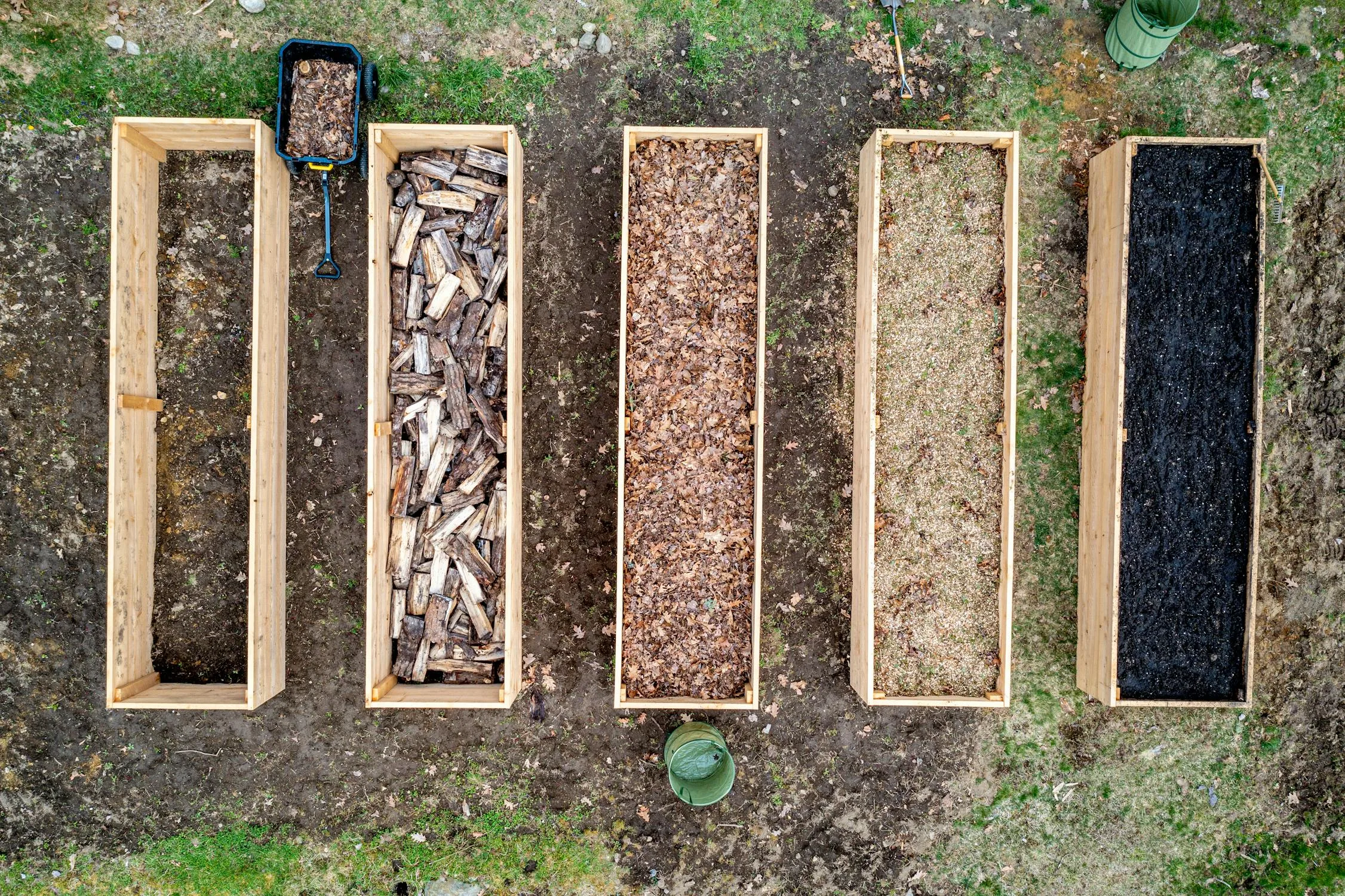
Filling a raised bed with bagged compost from the garden centre is incredibly expensive. A 1.2m × 2.4m × 0.3m bed holds about 860 litres of soil. At £5-8 per 40-litre bag, that’s over £100 in bagged compost alone. For one bed.
The Smart Fill Method
Bottom third: free/cheap bulk material – Woody garden waste, prunings, small branches, leaf mould – Partially decomposed cardboard (remove tape and staples) – Old straw or hay (not fresh — fresh nitrogen-robs the soil) We cover a similar decision in Best Raised Bed Compost 2026: Ready-Mixed Bags Tested.
This material breaks down over time, feeding the soil from below. It also saves you buying a third of the soil volume.
Middle third: budget topsoil Buy loose topsoil in bulk. Most landscape suppliers deliver by the tonne bag (approximately 800-1,000 litres).
Expect to pay: £30-60 per tonne bag delivered, depending on your area
Top third: quality compost This is where your plants’ roots will be in the first season. Use a 50/50 mix of multi-purpose compost and well-rotted farmyard manure (or mushroom compost).
Expect to pay: £2-4 per 50-litre bag of manure, £4-8 per bag of multi-purpose compost. Or buy in bulk from a local farm — infinitely cheaper.
Total Cost to Fill
For a 1.2m × 2.4m × 0.3m bed using the smart fill method: – Bottom layer (free garden waste): £0 – Topsoil (half a tonne bag): £15-30 – Compost and manure: £20-40 – Total: £35-70 vs £100+ for all bagged compost
Where to Get Cheap Compost
- Council green waste compost — many UK councils sell compost made from collected garden waste. Usually £5-15 for a large bag or trailer-load. Quality varies but it’s hard to beat the price
- Local stables — horse manure (well rotted, 6+ months old) is often free. Ring around riding schools and stables. They’ll be glad to get rid of it
- Allotment sites — many have communal compost heaps
- Mushroom farms — spent mushroom compost is excellent and often very cheap in bulk
- Your own compost bin — not helpful immediately but a bin started now produces usable compost in 6-12 months
What to Grow First

For absolute beginners, start with crops that are hard to kill, produce quickly, and reward you with something tasty in weeks rather than months:
Quick wins (harvest in 4-8 weeks): – Salad leaves (cut-and-come-again mixes) — sow March to September, harvest within 4-6 weeks, cut and they regrow – Radishes — sow to harvest in 4-5 weeks. Almost impossible to fail – Spring onions — sow March onwards, pull in 8-10 weeks – Herbs (basil, coriander, parsley, chives) — buy as plug plants for instant results, grow from seed for pennies
Reliable producers (harvest in 8-14 weeks): – Courgettes — one plant produces prolifically from July to October. Two plants feed a family – Runner beans or French beans — sow May, pick from July. Beautiful flowers too – Peas — sow March-June, harvest June-September. Kids love picking and eating them raw – Tomatoes (bush varieties like Tumbling Tom) — in a sheltered, sunny bed they do well outdoors in the South. Use grow bags or pots in the North
Avoid in year one: – Brassicas (cabbage, broccoli, cauliflower) — fiddly, slow, pest-prone – Root vegetables in shallow beds (need 40cm+ depth) – Sweetcorn (needs more space than a single raised bed provides) For independent guidance, check RHS gardening advice.
First Year Maintenance
Watering
Raised beds dry out faster than flat beds because drainage is better and the sides lose moisture. In a dry UK summer (yes, they exist), you’ll water every 1-2 days. In a normal summer, every 2-3 days.
Water in the morning or evening, not midday. Direct the water at the soil, not the leaves. A watering can with a rose attachment works fine for a couple of beds. More than that, seriously consider a soaker hose laid along the bed surface — it saves time and waters more evenly.
Mulching
A 5cm layer of mulch (bark chippings, straw, or compost) on the soil surface reduces watering by 50%, suppresses weeds, and feeds the soil as it breaks down. Apply mulch after the soil has warmed up in spring (late April to May).
Feeding
Fresh compost and manure in the soil mix provides nutrients for the first season. From year two onwards, top-dress each spring with 5cm of fresh compost or well-rotted manure, and consider a general-purpose organic fertiliser (chicken pellets, blood fish and bone, or seaweed extract).
Weeding
Raised beds have far fewer weeds than flat beds because you’re starting with clean compost, not weed-seed-filled native soil. What does appear is easy to pull from the loose growing medium. Five minutes per bed, twice a week, keeps on top of it.
Common Beginner Mistakes
- Beds too wide — if you can’t reach the centre comfortably, you’ll step on the soil to weed. 1.2m maximum width, always
- Skimping on depth — 15cm looks like a raised bed but isn’t deep enough for most vegetables. Go 30cm minimum
- All compost, no topsoil — pure compost is too rich and too light. It shrinks noticeably as it decomposes and doesn’t hold plants well. Mix with topsoil for structure
- Forgetting to water — raised beds drain well. That means they dry out faster. Set a phone reminder if you need to
- Planting too densely — seed packet spacing instructions exist for a reason. Overcrowded plants compete for light, water, and nutrients, and none of them do well
- Ignoring slugs — copper tape around the bed edges, beer traps, and nematodes (Nemaslug) all help. Slugs can devastate seedlings overnight in a British spring
The Budget Breakdown
For one 1.2m × 2.4m × 0.3m raised bed built from scratch:
- Tanalised timber (150 × 25mm boards × 6): £20-35
- Corner posts (50 × 50mm × 4): £5-8
- Exterior screws: £5-8
- Soil and compost (smart fill method): £35-70
- Seeds (5-6 packets): £10-15
- Total: £75-135
You could cut this to under £50 with reclaimed scaffold boards, free manure, and council compost. Or spend £200+ on a ready-made kit with premium soil. Either way, the return in fresh vegetables from a single well-maintained bed easily exceeds the investment by midsummer.
The Bottom Line
A raised bed is the single best investment a new UK gardener can make. It bypasses years of soil improvement, makes growing food physically easier, extends the season, and produces results fast enough to keep you motivated through your first year.
Start with one bed. Fill it with decent soil. Plant things that are hard to kill. Water regularly. And by July, when you’re eating salad you grew yourself, you’ll understand why everyone who tries raised beds ends up building more.
Frequently Asked Questions
What should beginners grow first? Choose reliable crops such as salad leaves, herbs, courgettes, potatoes and tomatoes. They give visible progress without specialist kit.
How much sun do vegetables need? Most fruiting vegetables need 6-8 hours of sun. Leafy crops tolerate some shade, especially in hot spells.
Is an allotment expensive to start? It can be cheap if you reuse materials and buy only essential tools. Soil improvement and time matter more than expensive kit.
What should I check first with Raised Beds for Beginners: Where to Start? Start with the real use case, then check size, compatibility, running costs and maintenance. A product that looks good on paper can still be the wrong fit if it does not suit the room, routine or budget.
How do I avoid wasting money on Raised Beds for Beginners: Where to Start? Avoid buying on one headline feature alone. Compare the practical details, read the warranty or returns terms, and choose the option that solves your main problem rather than the one with the longest specification list.